
 Author: Andy Piper
Screening Standards Specialist
This blog is the second in a series we’re releasing exploring the ongoing evolution of ISO 20022 and what it means for sanctions screening.
In the first article, we looked at the ISO 20022 journey through the MT-MX coexistence period. In this second article, our focus turns to the impact to the industry of the November 2025 release, why the Swift Standards Release in November 2026 has been deferred, and what changes we can expect to see in 2027.
A brief recap: What ISO 20022 changed in November 2025?
Whilst there were multiple changes that went live last year, two were very significant:
- The end of the coexistence period for selected MT format messages for FI‑to‑FI cross-border payments – this meant that pacs.008.001.08 replaced MT103, pacs.009.001.08 replaced MT202, and pacs.009.001.08(COV) replaced MT202COV.
- The introduction of a hybrid address option – this was implemented in parallel by many RTGS/HVPS+ systems to support interoperability. The format requires the use of the Town Name and Country field elements of the structured address, alongside the use of the unstructured Address Line.
Whilst not mandated, it was ‘strongly encouraged’ by Swift and through Payments Market Practice Group guidance that financial institutions utilise this hybrid option (or if possible, migrate directly to the use of the fully structured address fields).
View from the industry: What was the impact of the November 2025 changes?
Through our ongoing discussions with financial institutions across the world, two clear findings have been identified:
- Organisations are seeing a higher alert rate
As of 2Q26, alert rates appear to have risen since November 2025. The causes for this are believed to be a combination of:
- Partial migration of MT tuning data prior to the end of the coexistence period
- Loss of automatic disposition data following the format change to MX
- Increased data points within MX messages leading to higher alert volume
2. Structured fields are the primary source of alerts
Alerts are predominantly generated from structured fields, particularly the Name field. Entities also appear to trigger more alerts than Individuals, Vessels and CTRP.
This provides good insight and has allowed for targeted tuning to address the key impacted fields.
The Swift Standards Release 2026: What happened?
The date for the removal of fully unstructured postal addresses from CBPR+ messages was agreed back in 2023, following discussions with financial institutions and Payment Market Infrastructures (PMI). Many PMI planned to coordinate timelines with Swift to harmonise the transition across the payment industry.
However, industry progress to meet the November deadline has been far from universal, and so to help preserve the integrity of the financial system, Swift agreed to extend this deadline. Each PMI with similar planned changes will have to make their own decision as to whether to proceed with their stated go-live dates or extend the deadline as well.
Whilst this was only one change within the wider Standards Release, Swift decided that there was insufficient time to remove this individual change whilst maintaining the others, due to the complex nature of testing new packages and undertaking full E2E testing again.
Therefore, in late August, Swift advised that the entire release was to be deferred to a later date, i.e. there would be no longer be a Swift Standards Release in 2026.
The Standards 2026 Deferred Release: What is the new date and impact to FIs?
Swift has announced that the new release date will be 12 June 2027, limiting this to changes not related to payments (both ISO 20022 and MT). Therefore, the key removal of fully unstructured postal addresses from CBPR+ messages will not go ahead at this time.
Overview of changes originally scheduled for Standards Release 20261
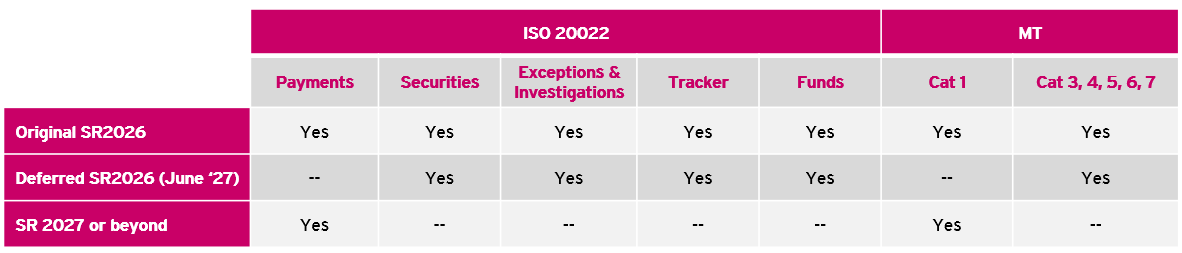
One key change that will now go live in June 2027 is the adoption of MX-like structured addresses, which will help to ease the transfer of address information through later payment instructions in the chain. These changes affect a substantial number of message types, particularly across the MT4 and MT7 series where new field options are being created (as per Swift Change Request 002101).2
Not only will these new field options require new mappings, but existing tuning solutions will need to be reevaluated, along with potential updates to automated disposition and resubmission detection engines.
As these mappings filter through to CBPR+ messages (where applicable), the benefit of structured addresses may begin to be realised before the fully unstructured addresses are finally removed.
For FIs, these changes to the release dates will require a significant replanning exercise, with knock-on impacts across not just screening but also internal payments, trade and securities infrastructure, with other parallel system changes which may also need to be rescheduled. There is also the impact to other planned deliverables to consider, as development, testing and support resources will be required to implement this deferred industry change.
Swift payment changes: What does the updated timeline look like?
Standards Release 2027 will also still go ahead in November next year as planned and Swift is currently assessing change requests for inclusion. Which of the payment change requests removed from the deferred release (including the removal of unstructured postal addresses) will make the cut is yet to be defined and requires further discussion across the payment community.
With these additional changes now having to be inserted into future releases, maintaining alignment with Swift’s high-level schedule for future standards releases will be a challenge.
How GSS approaches annual Swift standards releases
Every year, GSS assesses and documents the upcoming changes for both MX and MT messages and holds discussions with numerous institutions to validate the proposed amendments to screening.
These changes form part of the annual Targeted Screening Standard changes, part of the overall GSS Screening Standards that are discussed and agreed across the industry.
If you are interested in learning more about the Targeted Screening Standard or the wider GSS Screening Standards, please reach out to me for a chat.
Contribute to the GSS Sanctions Survey 2027
The industry’s experience since the November 2025 migration, together with the deferral of key ISO 20022 changes, highlights how quickly the sanctions screening landscape continues to evolve.
To better understand how financial institutions are responding to these developments, we’re currently running our third annual sanctions survey. The survey explores topics including ISO 20022 adoption, sanctions risks, screening effectiveness, data quality, emerging technologies and future investment priorities. The findings will be analysed and published later this year.
About the author

Andy Piper, Screening Standards Specialist, GSS
Andy has over 20 years’ experience across Tier 1 banking and RegTech, leading large-scale screening transformations and developing data-driven approaches to financial crime risk. As former Group Head of Screening Systems at HSBC, he was responsible for global screening strategy, platform evolution, and regulatory alignment, working closely with regulators, industry bodies, and technology providers. Andy brings deep expertise across sanctions and cross-border risk, screening system design and optimisation, governance, and global operating models, with a recent focus on advancing risk-based, intelligence-led screening approaches.
Footnotes